

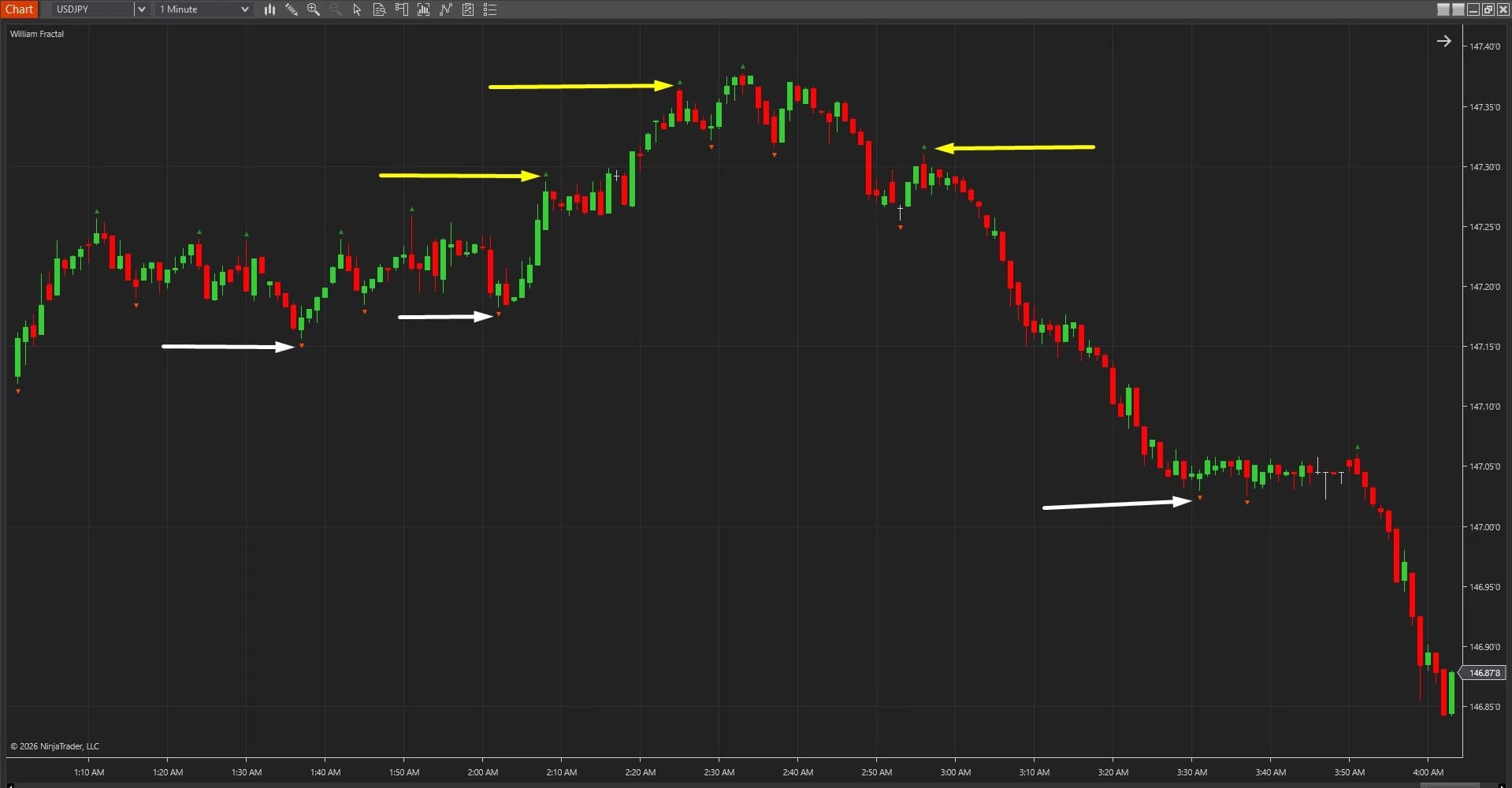
The William Fractal NinjaTrader 8 Indicator - Full Guide
Learn everything about the William Fractal NinjaTrader 8 Indicator created by Rize Capital that comes with full source code ownership once purchased.
If you trade on NinjaTrader 8 and want a cleaner way to identify swing highs and swing lows, the William Fractal indicator might be exactly what you need.
This indicator marks confirmed pivot points on your chart using the classic fractal concept developed by Bill Williams. It's simple, reliable, and comes with full source code so you can customise it or integrate it into your automated strategies.
Here's everything you need to know about the William Fractal indicator and how to use it effectively.
What Is the Williams Fractal Indicator?
The Williams Fractal indicator identifies key turning points in price action.
A fractal is a pattern where a middle candle's high or low stands out compared to the candles around it. When this pattern is confirmed, it marks a potential swing high or swing low.
The William Fractal indicator from Rize Capital automates this process. Instead of manually scanning charts for these patterns, the indicator does it for you and marks each confirmed fractal with a clear visual signal.
You get green upward triangles for swing highs and orange-red downward triangles for swing lows. These markers appear directly on your price chart, making market structure easy to read at a glance.
How the William Fractal Indicator Works
The indicator uses a strength parameter to confirm fractals.
Here's the basic logic: a swing high forms when a candle's high is higher than a specific number of candles on both its left and right sides. A swing low forms when a candle's low is lower than the same number of candles on both sides.
The "strength" setting determines how many candles the indicator compares. If you set strength to 2, the middle candle must be higher or lower than the 2 candles before it and the 2 candles after it.
This means fractals are confirmed, not predicted. The marker only appears after enough candles print on the right side to validate the pattern. So on the most recent bars, there's always a small waiting period. That's normal, and it's how fractals work.
This confirmation process helps filter out noise. You're only seeing swing points that meet specific criteria, not random bumps in price.
Key Features of the William Fractal Indicator
Let's break down what makes this indicator useful.
- Clear visual markers. Green triangles mark confirmed swing highs (high pivots). Orange-red triangles mark confirmed swing lows (low pivots). No clutter, no confusion.
- Adjustable strength parameter. You control how strict the confirmation is. Higher strength gives fewer, stronger pivots. Lower strength gives more frequent pivots that catch smaller swings.
- Triangle offset option. This doesn't change the pivot logic. It just shifts the triangle marker away from price so it stays visible on volatile instruments.
- Full source code included. When you download the William Fractal indicator from Rize Capital, you get the complete NinjaScript source code. You can modify it, extend it, or integrate it into your own strategies.
- Programmatic integration. Because you have the source code, you can reference these pivot signals inside automated trading strategies. Use them as entry filters, stop references, breakout triggers, or trailing logic.
Why Traders Use the Williams Fractal Indicator
Fractals help you see market structure objectively.
Instead of guessing where a swing high or low formed, the indicator shows you exactly where confirmed pivots occurred. This makes it easier to identify support and resistance levels, spot trend changes, and plan entries and exits.
- Trend identification. In an uptrend, you'll often see a sequence of higher swing highs and higher swing lows. In a downtrend, you'll see lower swing highs and lower swing lows. Fractals make these patterns obvious.
- Support and resistance. High pivot swings can act as resistance points. Low pivot swings can act as support points. When price approaches a previous fractal, you know it's testing a level that mattered before.
- Breakout trading. When price breaks above a recent high pivot or below a recent low pivot, it signals a potential breakout. Fractals give you clear reference points for these moves.
- Reversal signals. When fractals start forming in the opposite direction—like a low pivot after a series of high pivots—it can signal a trend change.
The indicator doesn't tell you what to do. It just shows you where the confirmed turning points are. How you use that information depends on your strategy.
How to Install the William Fractal Indicator
Installation is straightforward.
First, download the indicator file from Rize Capital. Once you have the file, open NinjaTrader 8.
Go to the Control Center, click Tools, then choose Import, then NinjaScript Add-On. Select the downloaded file and follow the prompts.
If NinjaTrader asks you to restart, go ahead and restart so everything loads properly.
Now you're ready to apply it to a chart.
Applying the Indicator to Your Chart
Right-click on any chart in NinjaTrader. Click Indicators, then find and open the Rize Capital folder. Select William Fractal and click Add.
Once applied, triangle markers will appear at confirmed swing highs and swing lows directly on your price panel.
You'll notice the triangles don't appear immediately on the most recent candles. That's because the indicator needs to confirm the pattern with candles on the right side. Give it a few bars and the fractals will print once confirmed.
Customising the Indicator Settings
The William Fractal indicator has a few key parameters you can adjust.
Strength
This controls how strict the confirmation is. A higher strength value means the indicator compares more candles on each side of the pivot. You'll get fewer fractals, but they'll represent stronger, more significant swings.
A lower strength value gives you more fractals because the confirmation is less strict. This can be useful on lower timeframes or if you want to catch smaller swings.
Most traders start with a strength of 2 or 3 and adjust from there based on their timeframe and trading style.
Triangle Offset in Ticks
This setting shifts the triangle marker up or down from the actual pivot point. It doesn't change where the fractal is detected—it just moves the visual marker so it's easier to see.
On instruments with tight price ranges, you might not need much offset. On volatile instruments, increasing the offset keeps the triangles from getting lost in the price action.
Plot Customisation
You can change the colour and thickness of the high pivot and low pivot markers. If green and orange-red don't fit your chart theme, adjust them to whatever works for you.
All these settings are in the indicator properties window. Just right-click the chart, go to Indicators, select William Fractal, and click the wrench icon to edit.
Using Fractals in Your Trading Strategy
Here's how you might actually use this indicator.
Identifying trend direction.
Look at the sequence of fractals. Are you seeing higher highs and higher lows? That's an uptrend. Lower highs and lower lows? That's a downtrend.
Once you identify the trend, you can trade pullbacks in the direction of that trend. Wait for price to retrace to a previous fractal, then look for entries when price bounces off that level.
Setting stop losses
Fractals give you logical places to set stops. If you're long, place your stop below the most recent low pivot fractal. If you're short, place it above the most recent high pivot fractal.
This way, your stop is outside the recent structure. If price takes out that fractal, the market structure has shifted and your trade thesis is probably wrong.
Breakout entries
When price breaks above a high pivot fractal, it signals potential continuation to the upside. When it breaks below a low pivot fractal, it signals potential continuation to the downside.
You can use these breakouts as entry triggers, especially when they align with other factors like trend direction, support and resistance, or volume.
Trailing stops
As a trade moves in your favour, fractals can help you trail your stop. If you're long and new low pivot fractals keep forming at higher levels, move your stop up to just below the most recent one.
This locks in profit while giving the trade room to breathe. You're only exiting if price breaks the recent structure.
Combining Fractals With Other Indicators
The William Fractal indicator works well on its own, but it's even more powerful when combined with other tools.
- Moving averages. Use fractals to identify structure, and moving averages to confirm trend. If fractals show higher lows and price is above a rising moving average, you have confluence for long trades.
- Support and resistance zones. When a fractal forms at a key support or resistance level, it adds weight to that level. The combination of historical price action and a confirmed fractal makes these zones more reliable.
- Volume. If a breakout above a high pivot fractal happens on increasing volume, it suggests stronger conviction. If it happens on declining volume, the breakout might be weak.
- Momentum indicators. Combine fractals with RSI or MACD to filter trades. For example, only take long trades at low pivot fractals when RSI is oversold, or only take short trades at high pivot fractals when RSI is overbought.
The key is not to overload your chart. Pick one or two complementary tools and use fractals as the foundation for reading structure.
Understanding Fractal Limitations
Fractals aren't perfect.
The biggest limitation is lag. Because fractals need confirmation from bars on the right side, they're always a few bars behind. You won't catch the exact top or bottom—you'll catch the confirmed swing point a few candles later.
In fast-moving markets, this can mean you miss some of the initial move. But the tradeoff is reliability. You're trading confirmed structure, not guessing at potential turning points.
Fractals also give more signals in choppy, sideways markets. When price isn't trending, you'll see fractals forming back and forth without much directional movement. This is normal. Fractals show structure, not trend strength.
And like any indicator, fractals don't predict the future. A low pivot fractal doesn't guarantee price will go up. It just marks a confirmed swing low. What happens next depends on overall market conditions.
Using the Source Code for Automation
One of the biggest advantages of the William Fractal indicator from Rize Capital is the included source code.
If you're developing automated strategies in NinjaTrader, you can reference the high pivot and low pivot values directly in your code. Use them as conditions for entries, exits, or filters.
For example, you might program a strategy that only takes long entries when price pulls back to a low pivot fractal and then shows a bullish reversal candle. Or you might code a trailing stop that adjusts based on the most recent fractal.
The source code is clean and well-documented. Even if you're not an advanced programmer, you can read through it and understand how the logic works. This makes it a learning resource as much as a trading tool.
And if you are a developer, the code becomes a foundation you can build on. Add custom alerts, integrate with other indicators, or modify the confirmation logic to fit your specific needs.
Real-World Example
Let's walk through a simple example.
Say you're trading ES futures on a 5-minute chart. You apply the William Fractal indicator with a strength setting of 2.
Price has been trending up. You see a series of higher high pivots and higher low pivots. Then price pulls back and forms a new low pivot fractal near the 20-period moving average.
This gives you a potential entry. The trend is up, price pulled back to structure (the fractal) and a dynamic support level (the moving average). You enter long with a stop just below the low pivot fractal.
Price rallies. As it moves higher, a new low pivot fractal forms at a higher level. You trail your stop to just below this new fractal, locking in some profit.
Eventually, price breaks below the most recent low pivot fractal. Your stop is hit, and you exit with a profit.
The fractals gave you entry structure, stop placement, and a trailing mechanism. You didn't need to guess—you followed confirmed pivots.
Who Should Use the William Fractal Indicator
This indicator is useful for different types of traders.
- Discretionary traders benefit from the visual clarity. You can quickly see where confirmed swings are and plan trades around those levels.
- Algorithmic traders and system developers benefit from the programmatic access. You can integrate fractal logic into automated strategies without building the detection logic from scratch.
- Swing traders benefit from the higher timeframe structure. Fractals on daily or 4-hour charts can show major turning points for position entries and exits.
- Day traders can use fractals on shorter timeframes to identify intraday structure and plan scalp or momentum trades.
Basically, if you care about market structure and want an objective way to identify swings, this indicator helps.
Getting Started With William Fractal
If you're ready to start using the William Fractal indicator, head over to Rize Capital and download it.
Start with the default settings and apply it to a chart you trade regularly. Watch how the fractals form over a few sessions. Notice where they appear in relation to trends, pullbacks, and breakouts.
Once you're comfortable with how it works, experiment with the strength parameter. Try higher values for cleaner, stronger swings. Try lower values for more frequent signals.
If you're a developer, open the source code and explore the logic. See how you can integrate it into your own strategies or modify it to fit your needs.
The indicator is straightforward, but like any tool, it takes practice to use effectively. Give yourself time to learn how fractals behave in different market conditions.
Final Thoughts
The William Fractal indicator gives you a clean, objective way to identify swing highs and swing lows on NinjaTrader 8.
It marks confirmed fractals with clear visual signals, helping you see market structure without guessing. You can use it for trend identification, support and resistance, breakout trading, stop placement, and more.
And because it comes with full source code, you can customise it, extend it, or integrate it into automated strategies.
If you trade on NinjaTrader and want better clarity on where real pivots are forming, the William Fractal indicator is worth exploring. Download it from Rize Capital and start trading with more precision.
Disclaimer
This article is for educational and informational purposes only. It is not financial advice, investment advice, or a recommendation to buy or sell any financial instrument. Trading in futures, forex, stocks, and other financial markets involves substantial risk of loss and is not suitable for everyone. Past performance does not guarantee future results. The purchase price for the William Fractal indicator covers the programming effort and implementation, not the underlying fractal concept developed by Bill Williams. Before making any trading decisions, you should consult with a qualified financial advisor and conduct your own research. Rize Capital and the author of this article are not responsible for any trading losses you may incur.

Shariful Hoque
SEO Content Writer
Shariful Hoque is an experienced content writer with a knack for creating SEO-friendly blogs, marketing copies and scripts.
Related Posts

Best Free NinjaTrader Indicators That You Should Always Keep
Discover the best free NinjaTrader indicators that can enhance your trading strategies. Improve and automate your trades with these essential tools.

Top 10 Ninjatrader 8 Indicators You Should Use to Enhance Your Trading
Discover the top 10 NinjaTrader 8 indicators to enhance your trading. Keep them in your arsenal to stand out!

What Are NinjaScript Strategies in NinjaTrader 8?
Learn about NinjaScript strategies in NinjaTrader 8, how they work, and how to automate your trading with custom conditions and indicators.